
I see this every day, in my patients, in parents, in students, even in high-performing professionals. People are constantly online, constantly connected, and still… something feels missing.
That is the loneliness epidemic.
At the Phreedom Foundation, we talk about this often. Technology is not bad. But when it replaces real connection instead of supporting it, something begins to shift—and not in a good way.
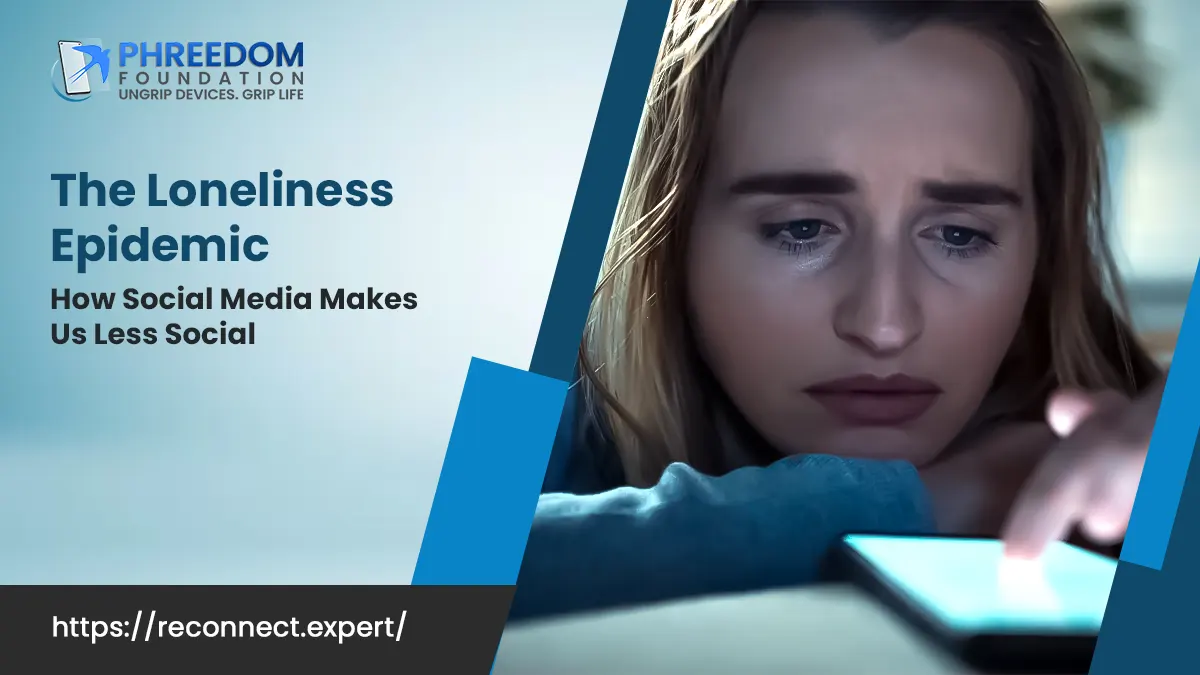
The loneliness epidemic simply means this: more people are feeling disconnected, even when they are not physically alone.
It is teenagers and adults.
It is people with full calendars and busy lives.
Earlier, connection was built into daily life. Conversations at dinner. Time with neighbors. Sitting together without needing a reason.
Now, much of that time has been replaced by screens.
We are connected online.
But often disconnected in real life.
Social media was meant to connect us. And sometimes, it does!
But slowly, it has changed how we interact.
We send messages instead of meeting.
We react instead of talking.
We “like” instead of listening.
That may seem small, but over time, it adds up and reconditions our brain.
Because real connection is not built in quick reactions. It is built in presence. And presence is something screens quietly take away.
Open any social media app and it looks like everyone is living a full, happy life. Trips. Achievements. Celebrations. What you do not see are the quiet evenings, the hard days, the moments of epidemic loneliness.
But the brain does not always remember that. It compares. And comparison creates distance.
People start to feel like they are the only ones struggling. Like everyone else is doing better.
That feeling grows quietly. And that is one of the reasons epidemic of loneliness is increasing even in a “connected” world.
Think about how often we reach for our phones. First thing in the morning, in between tasks, during conversations, right before sleep. Sometimes even when we are sitting with someone.
A notification comes in. We glance down. End of conversation.
It may seem small. But it happens again and again. And connection requires attention.
When attention is divided, connection weakens.
This kind epidemic of loneliness does not always feel obvious. It builds slowly.
You might notice:
Digital well-being is not about giving up technology. It is about using it in a way that supports your life, not replaces it.
When screens take over too much of our time, we start to see the effects:
For example:
When we restore balance, things begin to shift back.
This is why, at the Phreedom Foundation, we reinforce balance. Not removing technology completely, just using it wisely.
There is a reason a simple conversation with a friend can change your whole day. Because real connection is different. We are wired for real interaction.
You hear tone. You see expressions. And You feel understood.
A message, an emoji, a “like” cannot replace that!
This is not about throwing your phone away! It is about small, intentional changes:
At first, it may feel uncomfortable. That is okay. That discomfort is your brain resetting!
At Phreedom Foundation, we are not anti-technology. We are pro-balance.
Phones are useful. Social media can be helpful (maybe!). But they should not take the place of real life.
At the Phreedom Foundation, our goal is simple:
Help people reclaim their time, attention, and connection.
Because when attention comes back, connection follows.
The world today is more connected than ever before, yet many people still feel lonely. That is the strange truth of modern life. The epidemic of loneliness is not just about being alone, it is about missing real connection.
Phones and social media are now part of everyday life. They are not going anywhere, but how we use them matters. When we take small steps toward digital well-being, life begins to feel lighter again.
At the Phreedom Foundation, we are working to help people understand the epidemic of loneliness and build healthier habits with technology. The goal is simple: to help people create better digital well-being without completely giving up technology.
More real conversations. More laughter. More moments without screens.
And slowly, the loneliness so many people feel today might begin to fade.