
Ask teachers what has become harder in the classroom, and many will tell you the same thing: holding students' attention.
It's easy to blame children. But look at the environment they're growing up in.
Before school, there may be texts, videos, games, and notifications. During school, students may move from a smartphone to a Chromebook or tablet. After school comes online homework, followed by gaming, social media, YouTube, or more texting.
Their attention rarely gets a break.
The question is, “What are we asking their attention to compete with?”
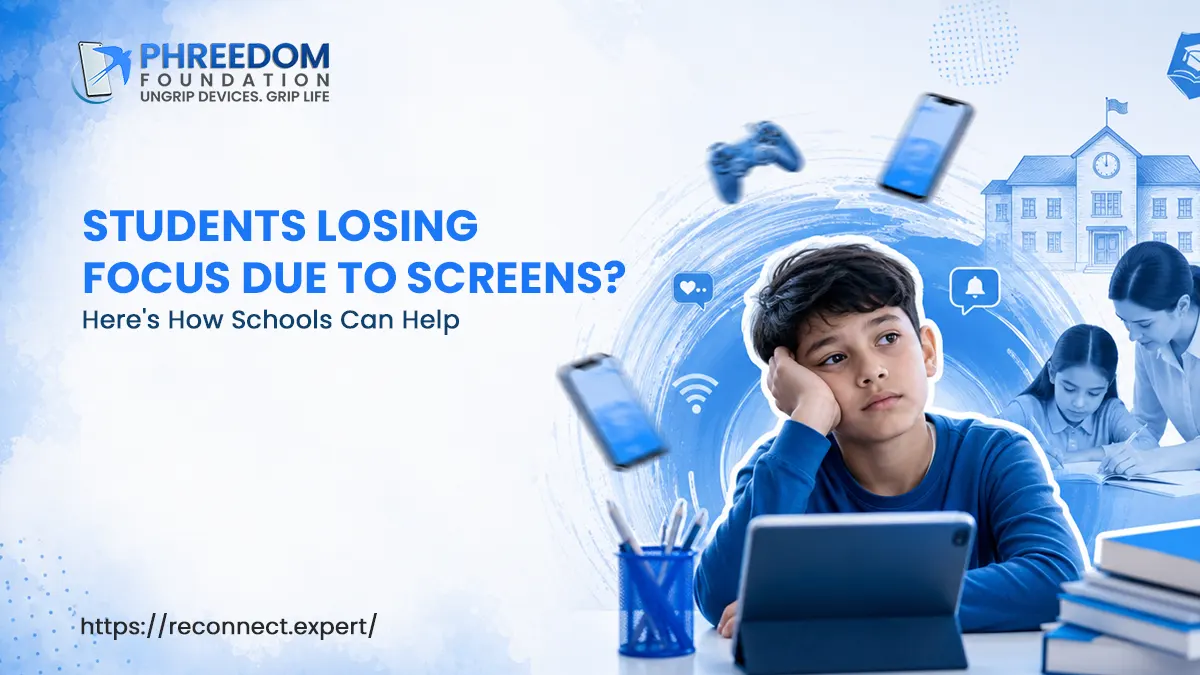
Not all screen use is the same, and technology itself isn't the enemy.
The challenge is that many digital experiences encourage rapid shifts in attention. Notifications interrupt us. Short-form videos offer something new every few seconds. Social media feeds never end.
Then we ask a child to put the device down and spend 30 minutes reading a chapter, solving a difficult math problem, or listening to a teacher.
Those activities require a very different skill: sustained attention.
And sustained attention needs opportunities to develop.
If every moment of boredom, waiting, or difficulty is interrupted by digital stimulation, children have fewer opportunities to practice staying with something that isn't instantly rewarding.
Bell-to-bell phone-free school policies are one of the most important steps schools can take.
A student should not have to resist texts, notifications, social media, and games while simultaneously trying to learn.
We shouldn't make children exercise eight hours of willpower when we can simply change the environment.
Keeping personal devices inaccessible during the school day creates protected time for learning, conversation, movement, and face-to-face connection.
But phone-free policies and digital wellness education do different jobs.
A phone-free policy protects attention during school. Digital wellness education teaches students how to protect their attention when nobody else is doing it for them.
We need both.
Most students already know adults want them to spend less time on their phones.
What they may not understand is why they reach for one almost automatically.
Why does “five minutes” of scrolling become 45? Why is it so difficult to ignore a notification? Why does studying feel harder when the phone is sitting beside them? Why can late-night scrolling leave them exhausted the next morning?
This is where a digital wellbeing speaker for schools can change the conversation.
Instead of another lecture about screen-time limits, students can learn about:
The goal isn't to make students feel guilty about technology.
The goal is to help them recognize that their attention has value—and teach them how to protect it.
Attention doesn't exist in isolation.
Consider a teenager scrolling late into the night. Less sleep can mean greater fatigue the next morning. Fatigue can make it harder to concentrate, learn, regulate emotions, and participate in school.
Social media can add another layer. Constant comparison, pressure to respond, fear of missing out, and the feeling of always needing to be available can be exhausting.
Sometimes what looks like a motivation problem in the classroom may actually be a child who simply isn't getting enough opportunity to rest and recover.
That's why digital wellness belongs in the larger conversation about student mental health and well-being.
There is another piece of the attention conversation that schools need to examine: EdTech.
Removing smartphones while placing students in front of laptops for much of the school day doesn't fully address digital balance.
Educational technology can absolutely add value. But schools should be willing to ask:
Does this screen improve the learning experience—or is it simply replacing something that already worked?
Sometimes technology is the best tool.
Other times, a textbook, handwritten notes, classroom discussion, hands-on experiment, or simply looking at the teacher may better support the learning goal.
Digital literacy does not require digital immersion.
A school cannot solve this alone.
Parents play an enormous role too. Children notice whether we check phones at dinner, answer emails during conversations, or scroll while watching their soccer games.
Healthy digital habits become much easier when home and school reinforce each other.
That might mean:
None of these changes requires abandoning technology.
They require becoming more intentional about it.
Phreedom Foundation partners with schools and districts through evidence-based digital wellness workshops for students, parents, educators, and school leaders.
Our programs explore the science of attention, sleep, persuasive technology, mental health, and educational technology—and turn that knowledge into practical changes families and schools can actually use.
Because preparing students for the future isn't simply about giving them access to more technology.
In an increasingly distracted world, the ability to control one's attention may become one of the most important skills we can give them.
If your school is exploring phone-free policies, student attention, healthier EdTech use, or digital wellness education, Phreedom Foundation can help create a program tailored to your community.
Prepare students for a digital future—without digital dependency.