
It's Crucial to Preserve Childhood in the Digital Age
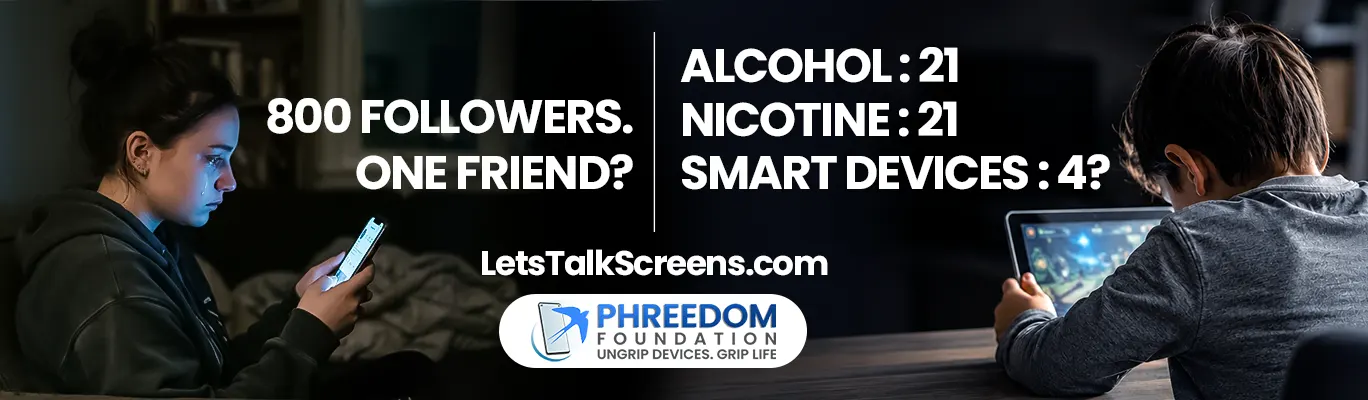
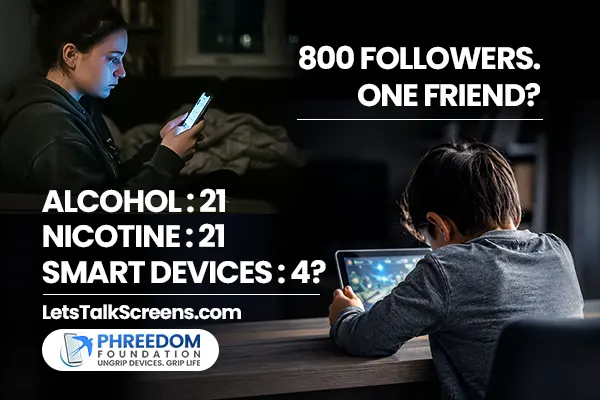
Alcohol and nicotine are age-restricted because we recognize the vulnerability of the developing brain. It's time to ask whether personal smart devices deserve the same thoughtful conversation.
The question is not whether children should learn to use technology.
It's when, how, and under what conditions technology should be introduced.
At Phreedom Foundation, we believe children can be prepared for a digital future without developing digital dependency. Through the Let's Talk Screens campaign, we are bringing parents, educators, and policymakers together to rethink childhood screen time, smart-device use, educational technology, and digital wellness.
Technology Has Changed.
Child Development Has Not.
Parents are trying to make the best decisions they can about smart devices and social media.
Educators are under increasing pressure to prepare students for an AI-driven future.
Policymakers are balancing innovation with child well-being.
The science of child development, however, remains remarkably consistent.
Children still need screen-free play, movement, sleep, real-life relationships, boredom, and deep learning.
The Conversation We Need to Have
Parents, educators, and policymakers are asking many of the same questions.
- When is the right age for a smart device?
- How much screen time is too much?
- What technology belongs at home and at school?
- How do we prepare children for AI without creating digital dependency?
- What role should educational technology play?
- Can willpower break screen habits?
Three Core Pillars
Technology is an extraordinary tool. It should never become the architect of childhood.
Device-Balanced Childhood
Helping families delay the introduction of personal smart devices until age 16.
Phone-Free Schools
Creating learning environments where attention and learning can flourish without personal-device distraction.
Device-Balanced Education
Preparing students for the future while protecting focus, deep thinking, and privacy.
Choose Your Next Step
Build a Device-Balanced Childhood
Learn practical, science-backed strategies for managing children's screen time, delaying smart devices, and setting healthy technology boundaries.
Parent ResourcesCreate Focused Learning Environments
Discover evidence-based approaches to student attention, phone-free schools, educational technology, and device-balanced learning.
Bring Phreedom Foundation to Your SchoolBuild Policies that Protect Childhood
Explore research, legislative initiatives, and practical policy solutions that prepare children for the future while protecting healthy development.
View Our Advocacy EffortsWhere Childhood Is Shaped
Educational technology should build digital literacy without creating digital dependency.
Phone-free schools help restore attention, connection, and readiness to learn.
7,000 hours a year at home
Children spend approximately 7,000 hours each year at home, compared with approximately 1,400 hours at school. Their first exposure to technology and earliest screen habits are largely shaped at home.
The Movement Is Growing
Childhood Is Worth Protecting
Technology is advancing rapidly. Child development has not changed.
Let's build a future where children learn to use technology as a powerful tool,
not as a substitute for childhood.
Let's talk screens. Let's protect childhood.