
Remember a time when going to school meant carrying a backpack full of textbooks, notebooks, pencils, and perhaps a calculator? Today, a single laptop can replace much of that. Students can access assignments, watch instructional videos, submit homework, communicate with teachers, and even receive AI-generated assistance, all from one device.
Pretty remarkable, isn't it? Sounds quite convenient and accessible. But, has it made education better?
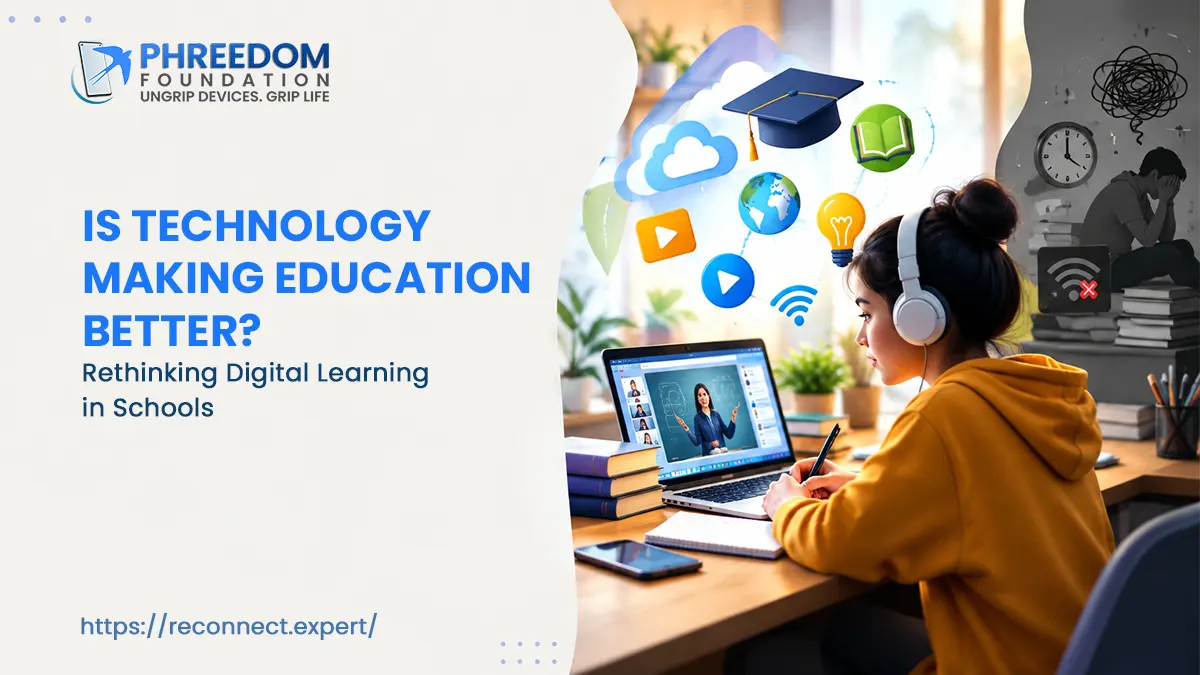
Children with certain learning differences can benefit from assistive technologies. Teachers can use simulations, videos, and interactive tools to explain concepts that may be difficult to demonstrate otherwise. During the COVID-19 pandemic, technology helped schools maintain some continuity of instruction when classrooms closed. And for educators, digital tools can simplify administrative tasks, grading, and communication. These are real advantages. But convenience and educational progress are not always the same thing.
Consider a typical student's day. Attendance may be recorded digitally. Lessons appear on a smartboard. Assignments are posted on a learning management system. Reading happens on a laptop. Homework requires logging into an app. Grades and teacher communications arrive through online portals. And that's before we account for recreational screen use.
Somewhere along the way, technology shifted from being an occasional educational tool to becoming the default environment in which learning takes place.
But does every classroom activity need a screen? Does every homework assignment need an internet connection? Does every reading exercise need an app?
One consequence of digital education that deserves more attention is the disappearance of natural breaks from screens. For previous generations, the school day provided many opportunities to disconnect from electronic media. Students read physical books, wrote in notebooks, worked with classmates, conducted experiments, and spent recess talking or playing.
Today, depending on the school, even activities that once provided a break from screens may involve digital devices. Children need movement, conversation, hands-on exploration, independent thinking, and opportunities to engage with their surroundings without a digital interface. When screens occupy too much of the day, these experiences can get crowded out.
And after school, many children return to an entirely different digital world of gaming, social media, videos, and messaging.
Think about it: Has technology made teachers' jobs easier? Maybe in some ways. But it also complicates a lot. Teachers may need to manage multiple platforms, troubleshoot login problems, monitor off-task behavior, respond to digital communications, and learn new systems as schools adopt them. A lesson that once required simply a textbook and a pencil may now depend on charged devices, functioning Wi-Fi, software access, and technical support. If a tool adds more work without improving the learning experience, schools should be willing to reconsider its role.
Imagine a school day where technology is used intentionally, rather than by default:
The goal is to distinguish digital literacy from digital dependency.
When schools encourage healthier technology habits but require hours of online homework, families receive conflicting messages. Likewise, when children spend most of their evenings on recreational screens, they may arrive at school tired and less prepared to engage.
Home and school are interconnected. Our approach to digital wellness should reflect that.
At Phreedom Foundation, we believe the future of education is about understanding where digital learning and traditional learning belong. Our digital wellness programs support schools, educators, parents, and students in creating healthier relationships with technology.
Through workshops, educator professional development, and school leadership conversations, we help communities explore practical ways to balance digital learning with the developmental needs of children.
Is your school reconsidering how technology fits into the classroom?
Phreedom Foundation partners with schools and districts to support phone-free learning environments, thoughtful educational technology policies, parent education, and practical digital wellness programs.
Let's prepare children for a digital future without creating digital dependency.
Learn more at Reconnect.Expert.