
Social Media Is Reshaping Our Children’s Minds, Moods & Mental Health
Youth anxiety has surged 300%. Suicide rates have risen 30%. And 1 in 5 teens is almost constantly on social media. This is not a parenting failure — it is a design crisis. Dr. Nidhi Gupta brings the science, the solutions, and the urgency your school or community needs to act.
TEDx Speaker • Pediatric Endocrinologist • Virtual & In-Person WorldwideWhat Social Media Is Doing to Our Children — Right Now
We are in the midst of a major mental health crisis and an emerging epidemic of loneliness. The data is alarming — and the connection to social media and wireless mobile devices is no longer deniable.
Anxiety & Depression Epidemic
Youth anxiety and depression have surged 300% as social media use has become near-constant — more “connected” online than ever, and more emotionally isolated than any previous generation.
Destroyed Sleep
Teens access social media in their bedrooms late at night. Sleep gets compromised — and sleep loss intensifies anxiety, depression and impulsivity.
Falling Academic Performance
Reading and math performance is sharply declining as device use rises. Perpetual notifications fragment the deep focus students need to learn and retain.
Loneliness & Isolation
Despite being hyper-connected through screens, young people report unprecedented social isolation, belonging deprivation and difficulty forming authentic friendships.
Obesity & Physical Health
With every extra hour of daily screen time the chance of weight gain rises. Screens have moved from living-room walls into children’s palms, displacing play and movement.
Suicide Rates Rising
Suicide rates have increased 30% alongside the rise in social media use. High screen time and low physical activity interact to increase depressive symptoms.
Science-Backed Sessions on Social Media & Youth — for Every Audience
Whether you are a school, parent organization, community group or education conference, there is a program designed precisely for your audience and goals.
Social Media, Screens & Your Superpower
An age-appropriate, powerfully engaging assembly for middle and high school students — blending neuroscience, real stories and interactive Q&A to inspire genuine reflection without shame.
- What social media does to your developing brain
- Why you check your phone even when you don’t want to
- FOMO, social comparison and mental health
- What you give up — and gain — by using tech intentionally
- Tools to use technology as a superpower, not an escape
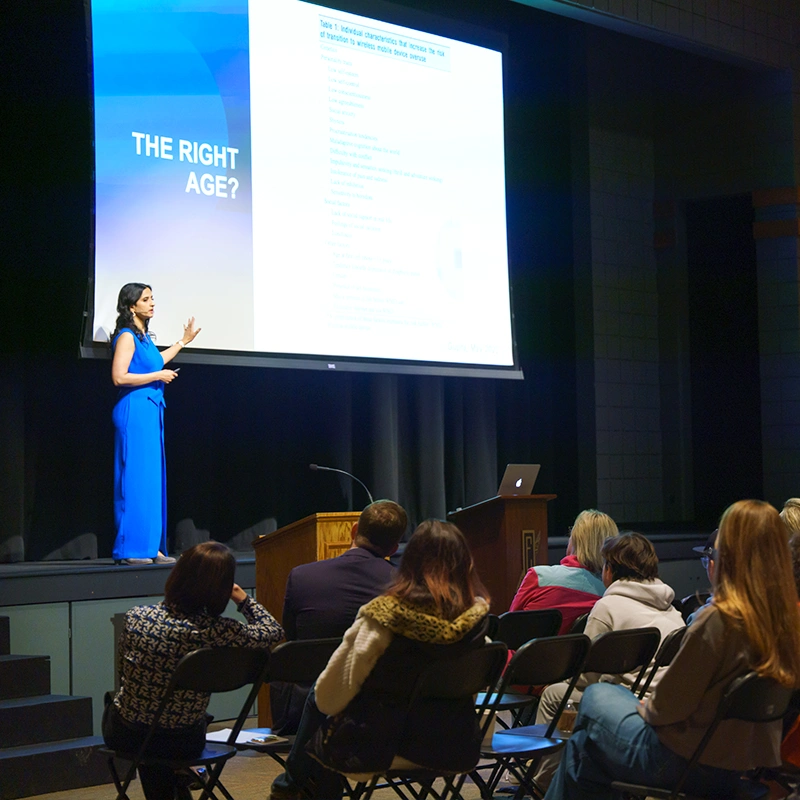

The Truth About Social Media & Your Child
A compassionate, science-backed session that arms parents with the knowledge, language and tools to set healthy digital boundaries and have real conversations about social media.
- When is the right age for smartphones and social media?
- How much screen time is too much?
- Can children self-regulate their tech use?
- Talking to your child about social media without conflict
- Building a community of like-minded families
Understanding Social Media’s Impact on Students
A professional development session that equips educators with the research, strategies and classroom tools to address social media’s effects on student learning, behavior and wellbeing.
- Brain development and social media in the classroom
- The link between social media use and academic decline
- Practical classroom management strategies
- Campus-wide digital wellness culture building
- How to talk to students about their devices compassionately
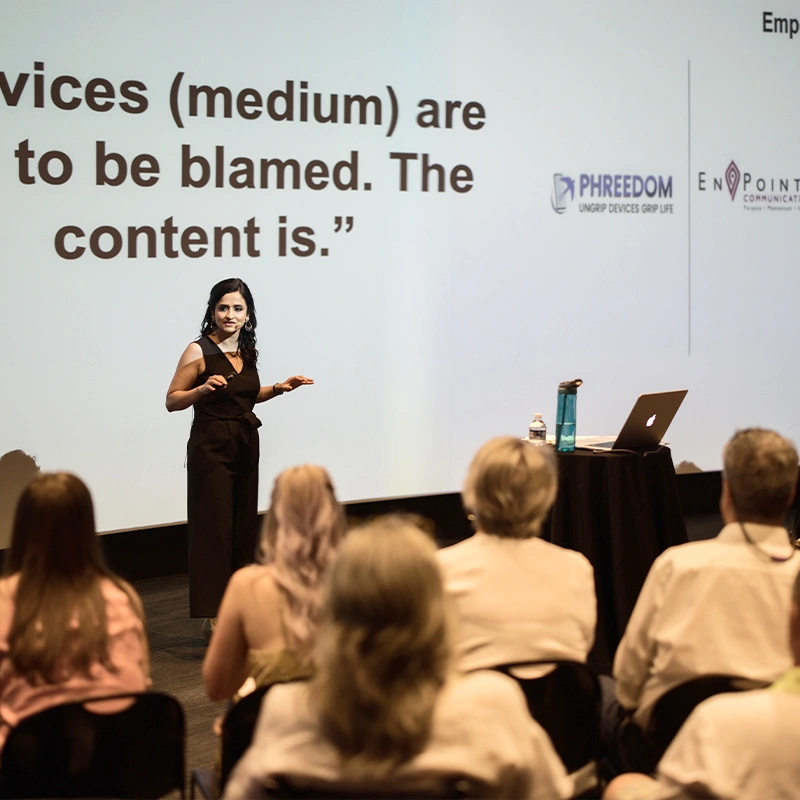
Protecting Our Youth in the Age of Social Media
A powerful whole-community keynote for civic organizations, faith communities, library events and local awareness initiatives focused on protecting children’s mental health.
- The case for urgent community action
- Social media’s design and its deliberate addictiveness
- Roles of parents, educators, policymakers and peers
- Advocacy and policy conversations your community can start
- Practical individual actions with immediate impact
Social Media, Mental Health & the Anxious Generation
A high-impact, conference-ready session for education summits, school counselor associations, child psychology conferences and pediatric health forums.
- Data-rich, research-backed conference format
- Panel discussion facilitation available
- Virtual and in-person delivery
- Configurable for breakout or plenary slots
- Cross-disciplinary relevance for diverse audiences

District-Wide Digital Wellness Initiative
A comprehensive, multi-session partnership for school districts committing to meaningful change — with sessions for students, parents, teachers and leadership across the entire community.
- Separate tailored sessions for each audience
- Policy design consultation for administrators
- Parent communication support
- Bulk copies of Calm the Noise for staff
- Follow-up resources and accountability sessions
The Most Documented Mental Health Effects on Youth
These are not hypothetical concerns. These are effects the clinical research — including Dr. Gupta’s own work — has documented extensively across children and adolescents.
Anxiety & Chronic Stress
Constant comparison, social performance pressure, cyberbullying fear and notification-driven hypervigilance wire young brains into chronic anxiety that spills into every area of life.
Depression & Low Self-Worth
Curated, filtered, idealized versions of peers’ lives fuel comparison and inadequacy. The feedback economy of likes becomes a proxy for self-worth — one that constantly disappoints.
Loneliness & Isolation
Digital socializing replaces in-person connection but cannot provide the embodied belonging, eye contact and reciprocal vulnerability developing youth need.
Sleep Disruption
Nighttime device use, blue light and the emotional arousal of social media consistently destroy sleep quality and quantity in young people.
Attention Fragmentation
The capacity for deep, sustained focus — critical for learning, creativity and emotional regulation — is progressively degraded by rapid-fire content and interruptions.
Behavioral Addiction
Repeated failure to resist an urge that feels rewarding short-term despite long-term harm: the patterns in addictive device use mirror those seen in drug addiction.
Dr. Nidhi Gupta
The Physician Who Saw the Crisis Coming
“Everyone is busy on the ‘touch screen,’ though no one is really ‘in-touch.’ Let’s come together to ungrip our devices and get a grip on life.”
Dr. Nidhi Gupta is a board-certified pediatric endocrinologist, TEDx speaker, bestselling author and founder of the Phreedom Foundation. She began her work on digital wellness in 2014 — long before social media’s impact on youth became a mainstream conversation — observing the connections between screen overuse and the anxiety, obesity, sleep disorders and academic struggles she saw in her patients every day. She followed the science where others followed the trend.
How the Dopamine Loop Takes Hold
Dopamine Is the Reward
Every notification, like or comment triggers a dopamine surge. The brain instantly “wants” to check — even subconsciously.
Anticipation Takes Over
The mind is conditioned: DING → CHECK. Eventually dopamine releases at the mere sight of the device, in anticipation of a reward that may not exist.
Behavioral Addiction
Repeated failure to resist an urge that feels rewarding short-term despite long-term harm — patterns that mirror drug addiction.
Developing Brains Are Vulnerable
The prefrontal cortex — impulse control and long-term decisions — is still forming. Dopamine loops reshape neural pathways before adulthood.
Calm the Noise
Essential Reading for Parents & Educators
A wake-up call to reclaim your time, attention and joy in a constantly connected world. Not a book about children’s screen time — a book about the adults who must shift their own habits first. Many schools include bulk copies as a takeaway from Dr. Gupta’s sessions.
Questions Every Audience Brings
Questions every parent needs answered
- When is the right age for a smartphone and social media?
- How much screen time is too much?
- Can children self-regulate their tech use?
- What about online gaming and peer pressure?
- What if my child is bullied online?
- How do I talk to my child about phone use without conflict?
- How do I build a community of like-minded parents?
Questions every educator needs answered
- How do screen habits affect developing brains?
- How is device overuse linked to poor reading and math scores?
- What is the impact on student mental health?
- What works — immediate, real-world classroom strategies?
- How do we build a campus-wide digital wellness culture?
- What do we tell parents who resist phone restrictions?
- How do we protect teacher wellbeing in this environment?
Questions young people are asking
- What if my friends only connect on social media and I feel left out?
- What if I am the only one without a smartphone and get bullied?
- Is smartphone use really harmful if I am still getting good grades?
- What if I see harmful content on a friend’s phone?
- Is it even realistic for teens to unplug these days?
- What could I actually do with all that freed-up time?
What do audiences take away?
Audiences don’t just leave informed — they leave changed. Attendees report an immediate perspective shift, reduced screen time the same day, better family conversations, empowered rather than shamed students, campus-wide shared language, and district-wide demand for follow-up sessions.
Are sessions available virtually?
Yes. Every program is delivered in person or live and fully interactive online, worldwide, with content customized for each audience and age group. Response within 24–48 business hours.
Ready to Bring the Truth About Social Media to Your Community?
Your students, parents and educators deserve clarity about the forces reshaping young minds. Book science-backed, compassionate, action-inspiring sessions that make a difference for years, not just a day.
- Book at reconnect.expert/connect
- Free discovery call: Schedule on Calendly
- Download: Speaker Media Kit
- LinkedIn: Dr. Nidhi Gupta